Single Match
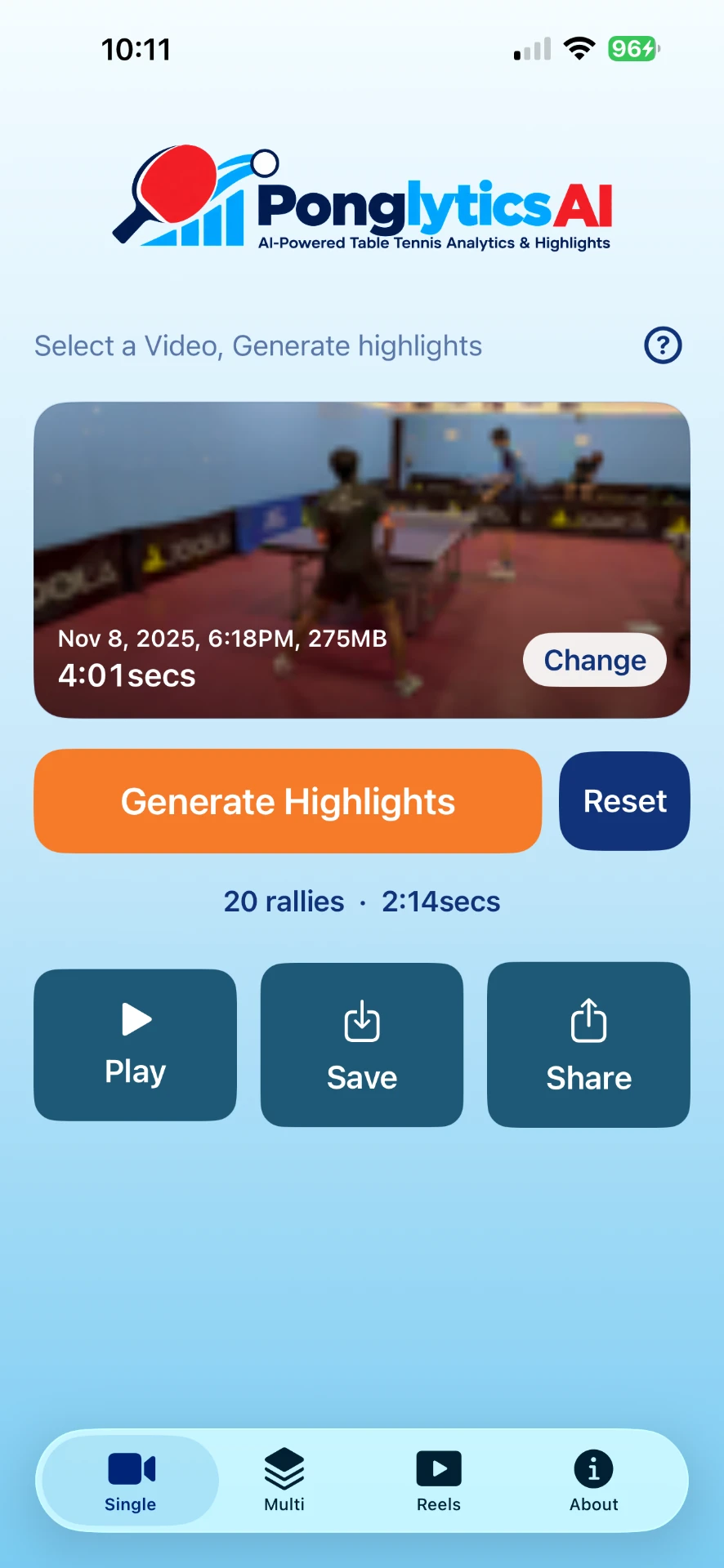
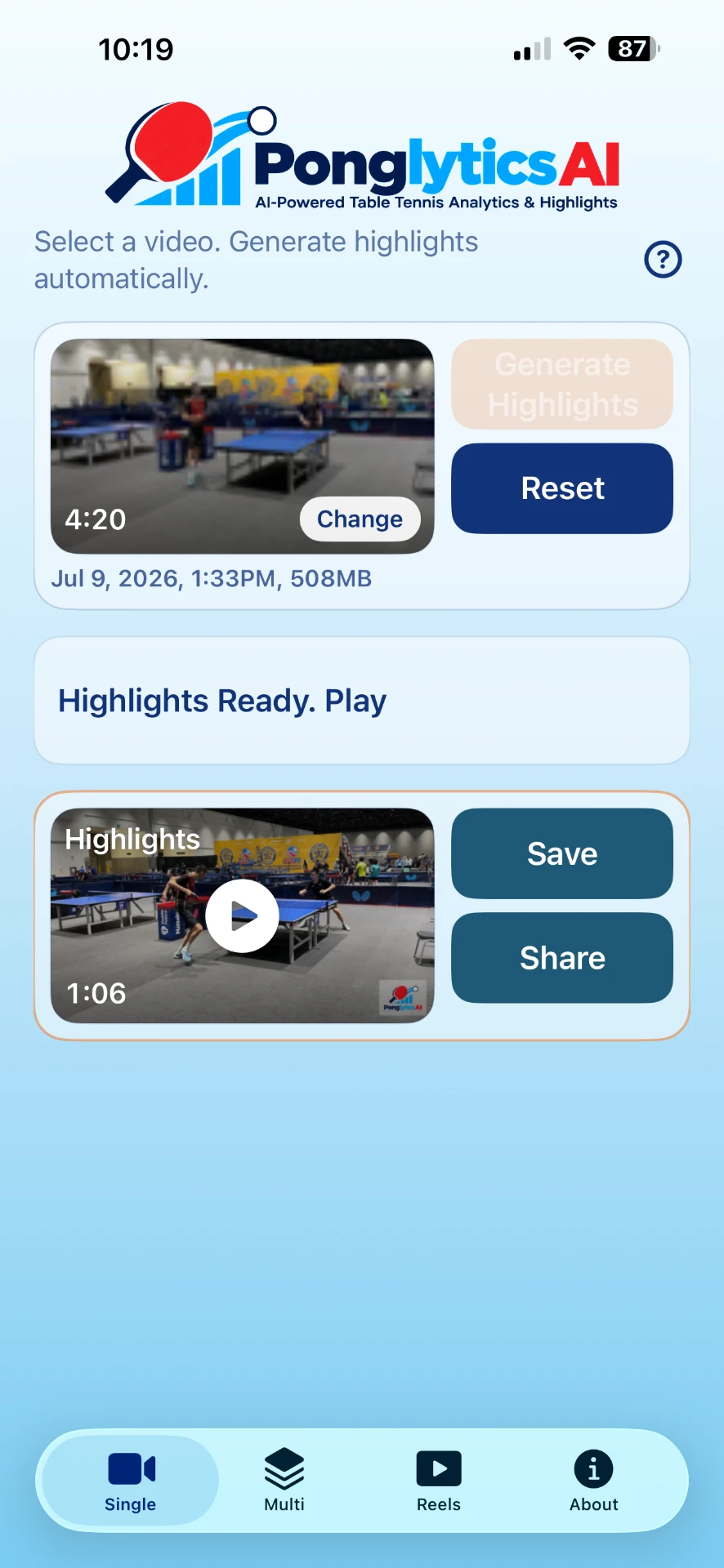
Select one recorded match and automatically generate a condensed highlight video containing the active gameplay.

AI-Powered Table Tennis Highlights. Right on Your iPhone.
Turn full-length table tennis matches into compact highlights using AI that runs directly on your device.
Ponglytics AI gives table tennis players flexible ways to turn recorded matches into highlights, whether working with a single match, multiple recordings, or individual rallies.
Select one recorded match and automatically generate a condensed highlight video containing the active gameplay.
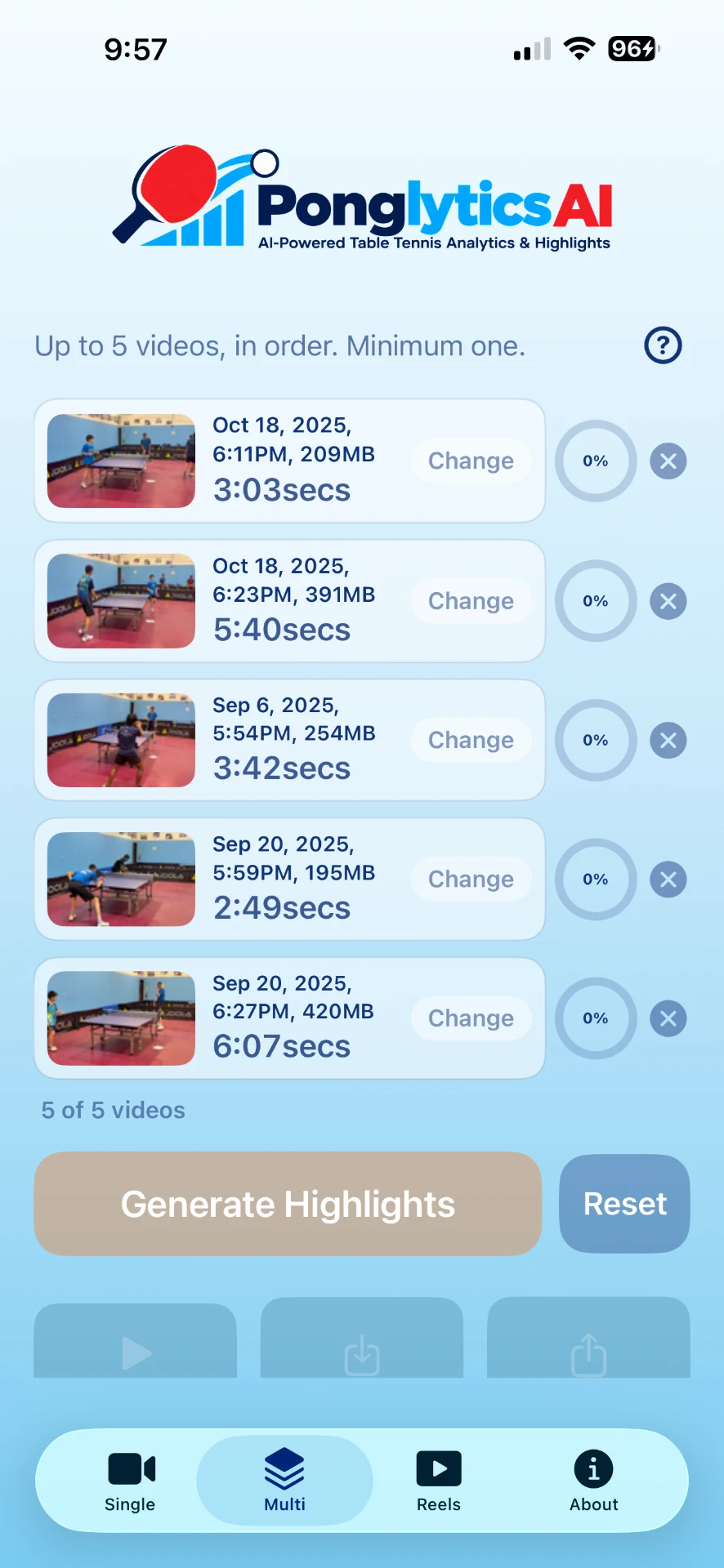
Process multiple match recordings and combine the detected gameplay into a single highlight video.
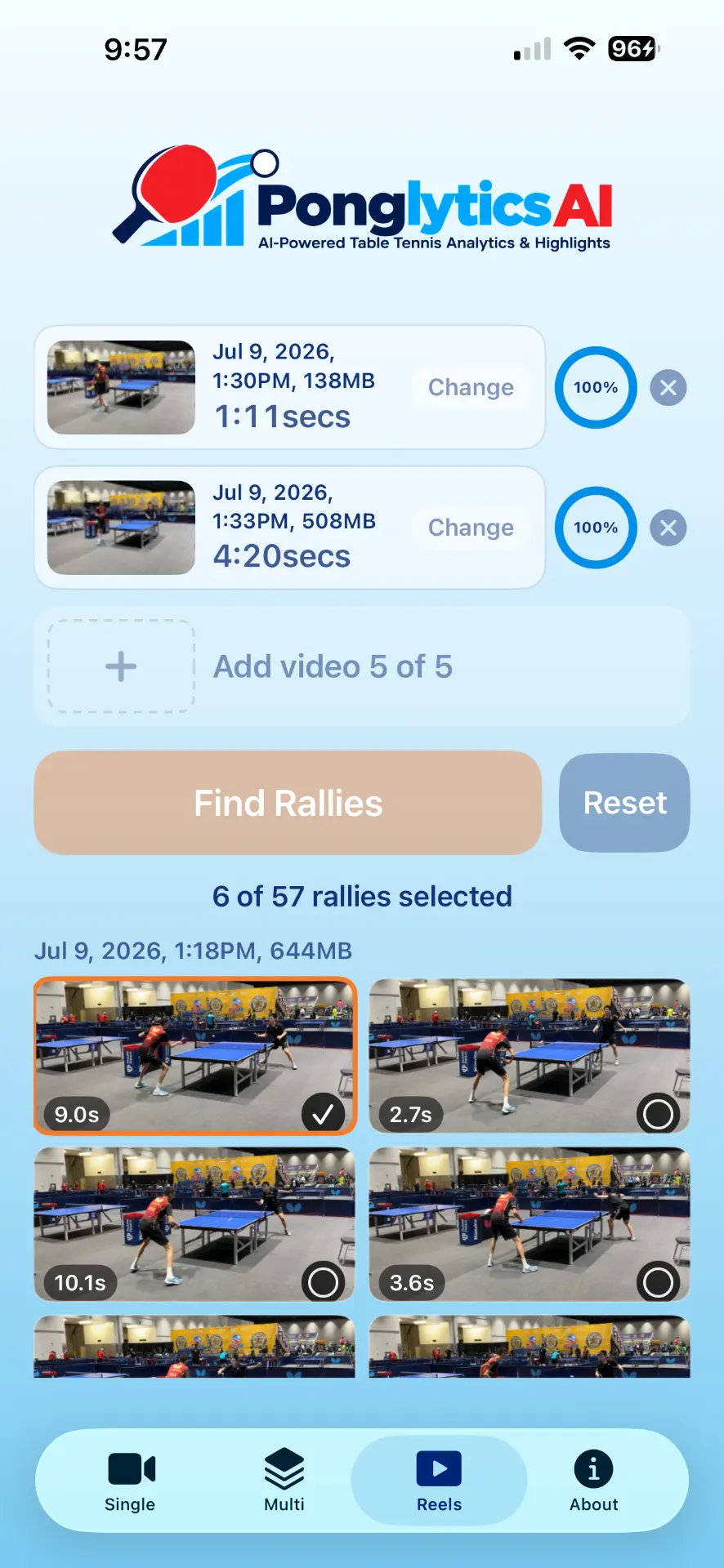
Identify individual rallies across recorded matches and select the moments you want for a customized highlight compilation.
A full table tennis recording contains rallies, breaks, setup time, and other inactive periods. Ponglytics AI analyzes the match and automatically identifies active gameplay to create a shorter highlight video.
Full-length match recording
Automatically generated highlight
The analysis and highlight detection are performed directly on the iPhone without uploading the match video to a cloud AI service.
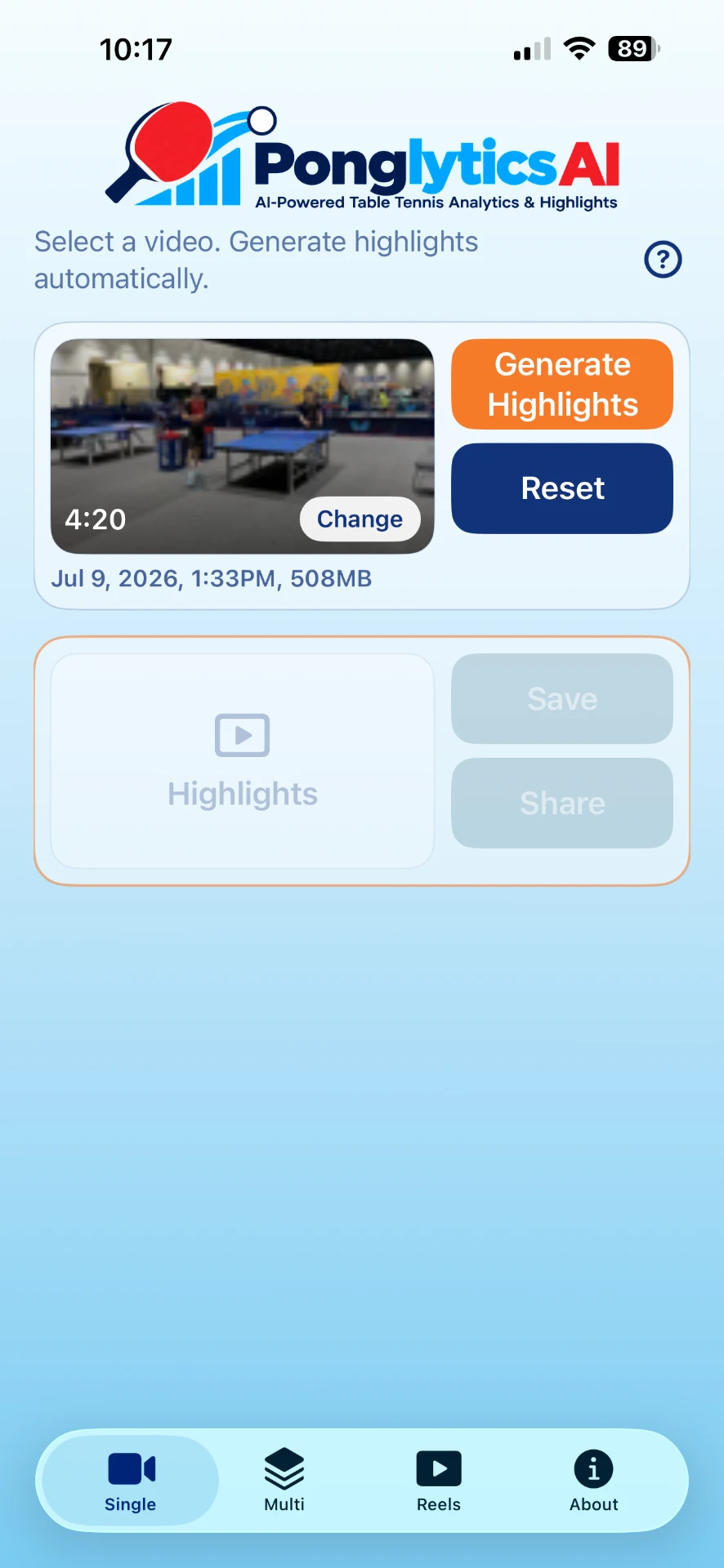
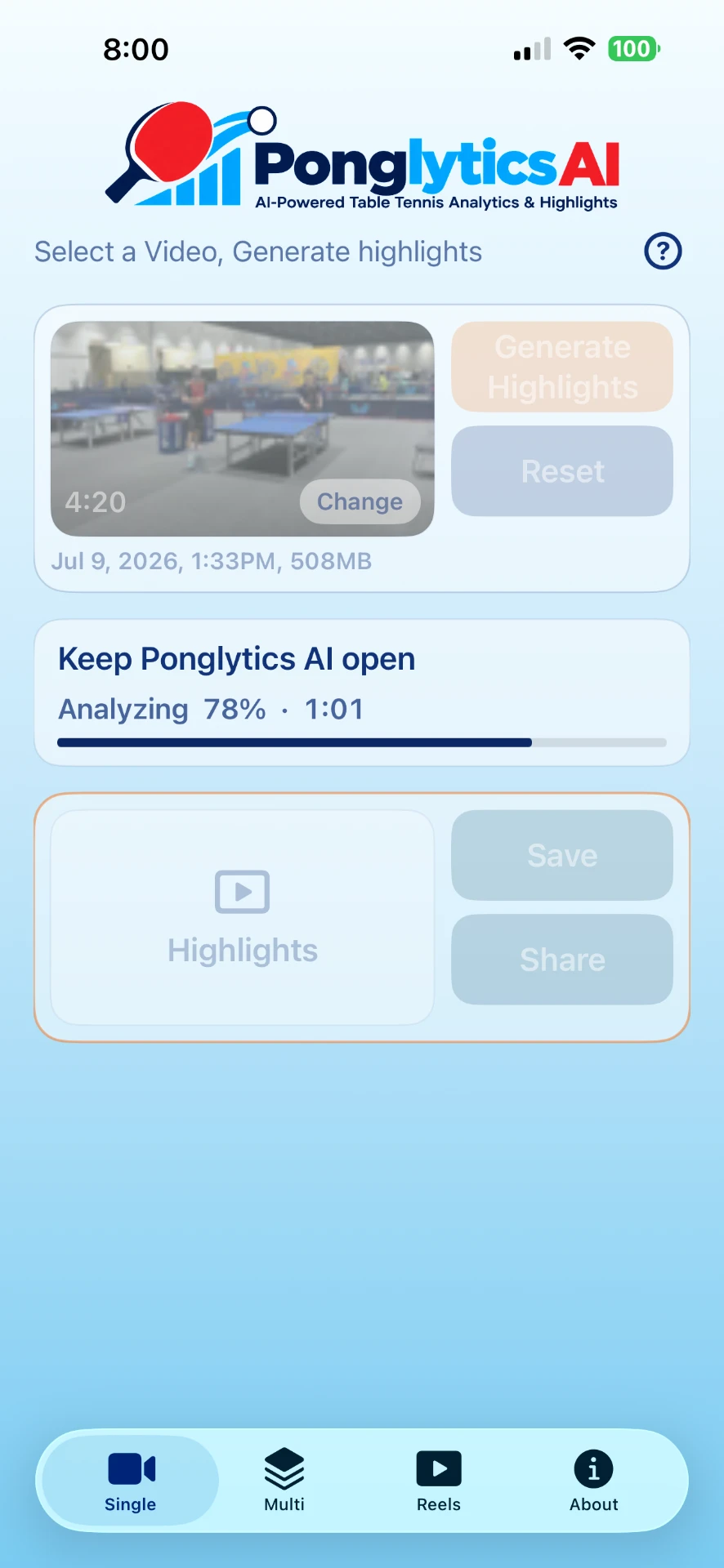
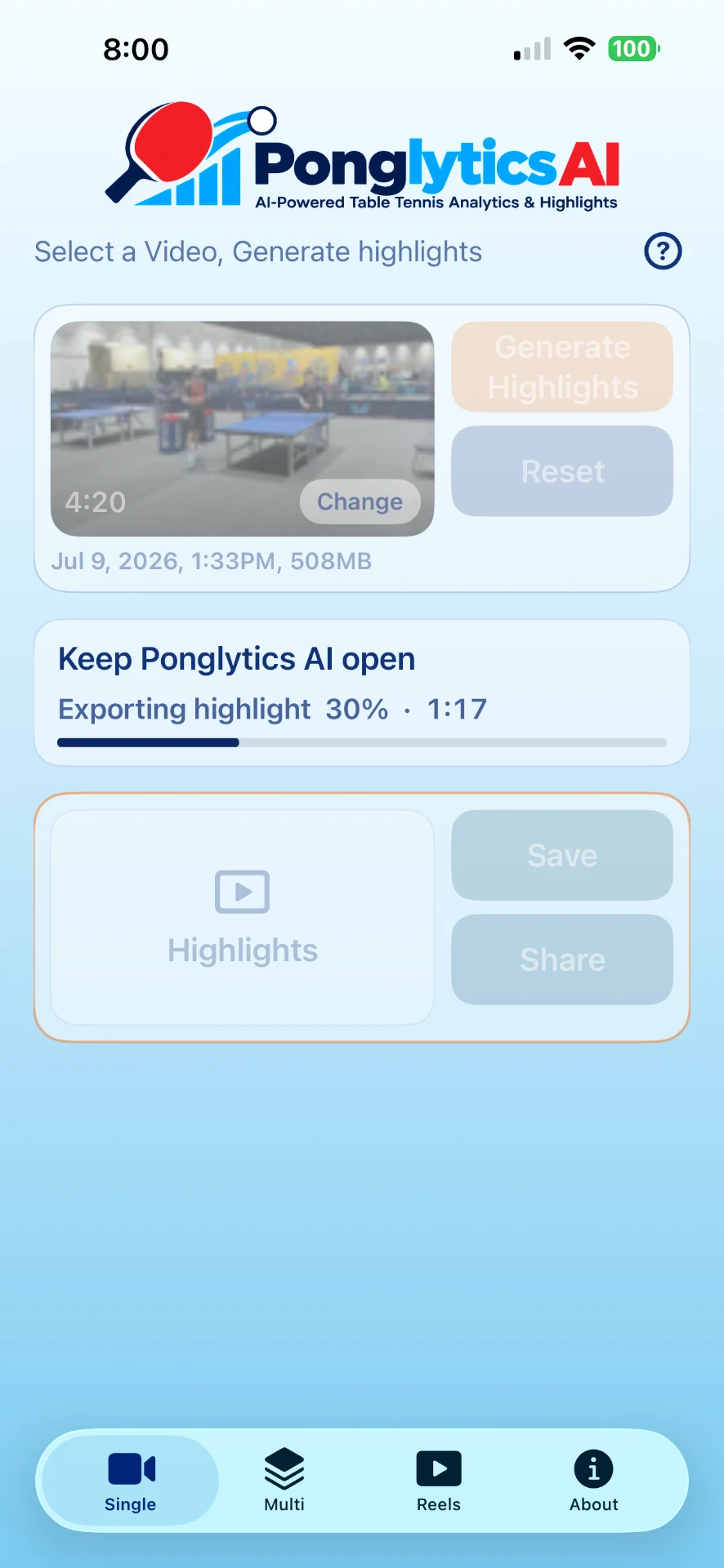
Choose a recorded table tennis match.
Ponglytics AI analyzes the video directly on the device.
The AI identifies periods of active gameplay.
Ponglytics generates a compact highlight video.
Ponglytics AI grew from research into automated analysis of amateur table tennis video and the challenge of bringing video AI from server environments directly onto consumer mobile devices.
National High School Journal of Science (NHSJS)
The research developed and evaluated an Action/No_Action video classification approach for automatically identifying active gameplay in untrimmed amateur table tennis recordings.
Read the Published PaperMoving video analytics from a server to a smartphone requires more than converting a trained model. Model development, computational workload, cross-platform behavior, and the capabilities of the target device must all be considered as part of the Edge AI system.
Server environments and Edge devices create different optimization priorities. Ponglytics AI evolved by reconsidering assumptions that are reasonable on a server but expensive on a mobile device.
Develop and validate the AI model with real-world deployment conditions in mind.
Design for the Edge from the beginning.
Reduce unnecessary computation through temporal sampling and full-video inference optimization.
Determine what computation is actually necessary.
Validate that server and mobile implementations preserve the same meaningful analytical results.
The deployed system should preserve analytical behavior.
Use native mobile video processing, Metal-accelerated preprocessing, and Core ML inference to execute the complete pipeline efficiently on-device.
Use the complete Edge platform—not only the AI model.
An end-to-end Edge AI workflow for on-device sports video analytics.
By Vishal Sivakumar · Creator, Ponglytics AI
I love table tennis.
I love playing table tennis. I love watching table tennis. I love coaching table tennis. I love talking about table tennis.
The sport has given me so much: joy, learning, lifelong friendships, success, and a sense of purpose. Ponglytics AI is one way I can give something back to the sport I love and the community I care about, while bringing in another passion of mine: math, analytics, and AI.
As a competitive table tennis player, I have recorded hundreds of my matches over the years. Most of them are now sitting in iCloud.
I do go back and watch them. Sometimes I am preparing to play someone I have faced before. Sometimes I want to understand what went wrong in a match against a tough opponent, especially one I felt I should have beaten. And sometimes I just want to relive a really good match.
But watching your own match video isn't quite like watching the professionals. I watch WTT highlights of top players on YouTube almost every day. They are fun because you get the table tennis without all the waiting in between.
And I kept thinking: Wouldn't it be nice if I could watch my matches that way too? No waiting between rallies. No picking up balls. No timeouts. No searching through a 30-minute recording to find the good points.
Serve. Rally. Done. Next point.
Then, while taking an AI class last summer, I had my light-bulb moment. Maybe I could train an AI model to do it.
At first, I thought this would be pretty straightforward. AI is supposed to be one of the smartest technologies on the planet. Surely it could figure out when two people were playing table tennis! And I had a super-smart PhD mentor, Abdulla Kerimov, helping me. How hard could it be?
As it turned out: quite hard.
Building Ponglytics AI has been an awesome experience, but it was definitely easier imagined than built.
The first challenge was teaching a computer what I could recognize instantly: Is a rally happening right now? That meant collecting real match videos, breaking them into examples, labeling periods of active gameplay and inactivity, training different versions of a model, testing them on matches the model had never seen, figuring out why it made mistakes, and trying again.
Over time, the idea became a research project. Instead of trying to teach AI every forehand, backhand, serve, block, and loop, I focused on the problem I actually wanted to solve: distinguishing Action from No_Action in a full, unedited table tennis match. Once that worked, the AI could move through a match, find the periods where table tennis was actually being played, and turn them into highlights.
That research eventually became my first paper, "Automated Highlight Generation of Amateur Table Tennis Videos Using Machine Learning," published in the National High School Journal of Science in 2026.
That felt like a huge milestone. But there was still one problem. The AI worked on a computer. My table tennis videos were on my phone.
That led to the next question: Could the whole thing run directly on an iPhone?
I didn't want Ponglytics to be a research demo where someone had to upload a video to a server, run a program, and wait for a result. I wanted it to feel like an actual app. Pick a match. Let the phone analyze it. Get the highlights.
Making that happen became another journey of its own. A smartphone doesn't have the same resources as a server, so I had to rethink how much of each video the AI really needed to examine and how often it needed to run. I also discovered that moving an AI system from one computing platform to another can introduce subtle differences in how video is processed, differences small enough for us not to notice, but sometimes large enough for an AI model to notice.
Solving those problems eventually led to the second phase of the project: turning the original research model into an efficient on-device Edge AI system.
And finally, into Ponglytics AI.
Today, the app can take a recorded table tennis match, analyze it directly on the iPhone, identify the active gameplay, and create a much shorter highlight video, all without needing to upload the match to a cloud AI service.
The funny thing is that Ponglytics AI started because I was too impatient to sit through all of my own match videos. Now I have spent countless hours watching table tennis videos while labeling data, training models, testing algorithms, comparing outputs, debugging the app, and trying to figure out why the AI thought something was, or wasn't, a rally.
So I'm not sure this project has actually saved me any time yet. But hopefully it can save other players some. 😀
More importantly, building Ponglytics has let me bring together things I genuinely enjoy: table tennis, math, analytics, AI, and building something useful.
And I like that the project has come full circle. It started with hundreds of match videos sitting in my iCloud and one simple thought:
Wouldn't it be cool if I could watch my matches as highlights too?
Now I can.
Vishal
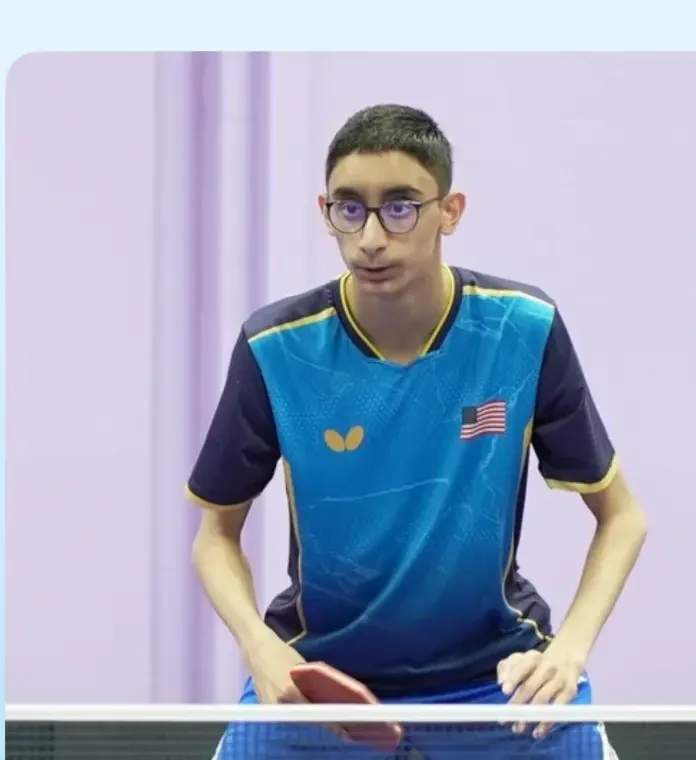
Ponglytics AI was created by Vishal Sivakumar, a high school student, competitive table tennis player, and researcher interested in the intersection of artificial intelligence, computer vision, mobile software, and sports. His experience playing and recording competitive table tennis inspired him to explore how AI could make amateur match video easier to review and use. Ponglytics AI brings those interests together as both a practical iPhone application and an ongoing research and engineering project. Vishal is a three time USA junior national team player and has participated and won USATT and WTT Youth tournaments in his career.
Ponglytics AI brings automated table tennis highlight generation directly to the iPhone using on-device Edge AI.